← Back to WP3 Peptides & Research Index
What AOD-9604 is
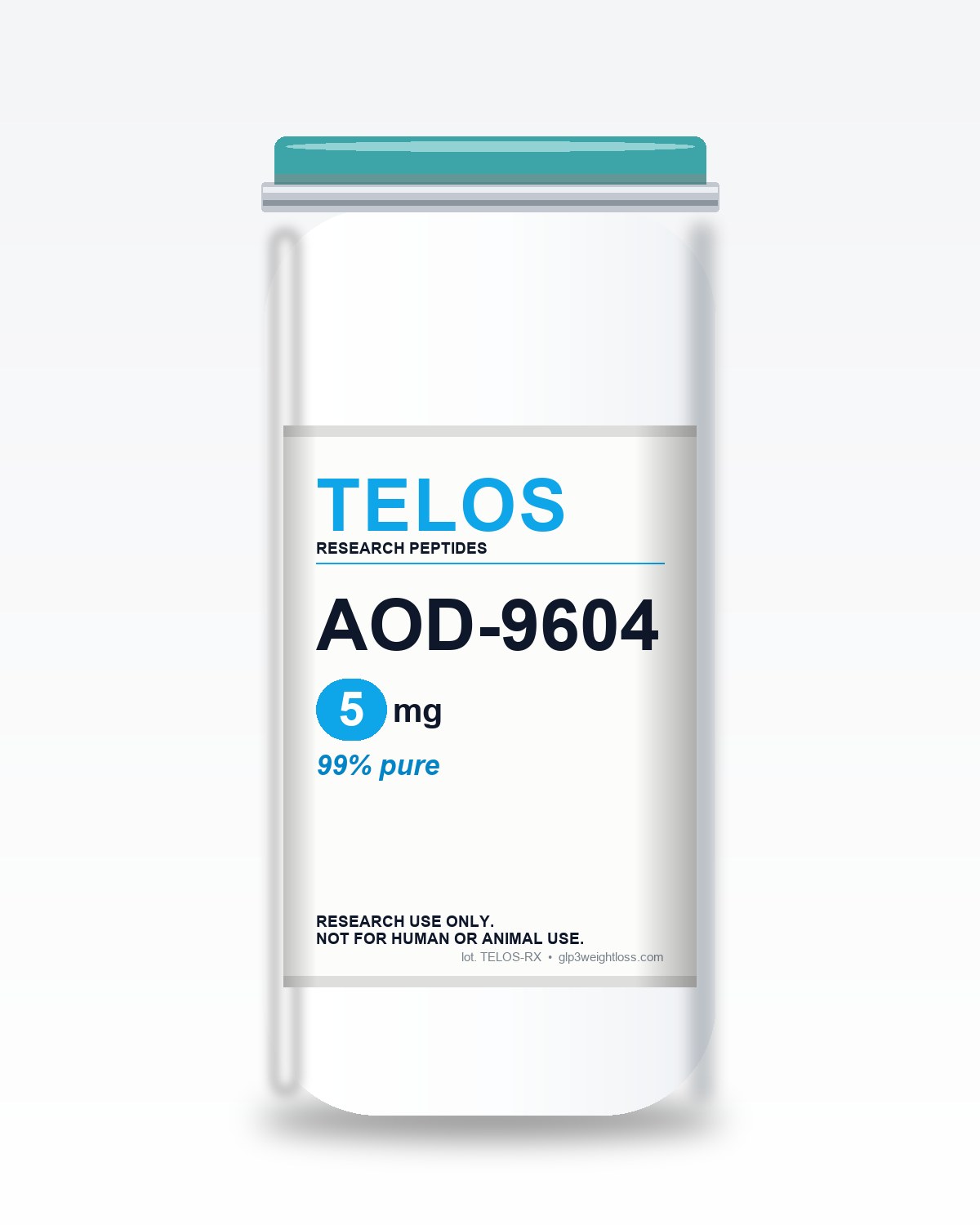
AOD-9604 (Anti-Obesity Drug 9604) is a synthetic peptide corresponding to the C-terminal fragment of human growth hormone, comprising amino acids 176–191 with an additional N-terminal tyrosine residue (Tyr-hGH 177–191). The fragment was developed by Metabolic Pharmaceuticals in the 1990s based on prior work by Ng and colleagues identifying a lipolytic domain within the GH C-terminus distinct from the regions responsible for GH's somatotropic and diabetogenic effects (Heffernan et al., 2001). The peptide is investigated in pre-clinical models of adipocyte metabolism.
Mechanism of action
The proposed mechanism of AOD-9604 is stimulation of lipolysis and inhibition of lipogenesis in white adipose tissue, with effects that are partly distinct from canonical growth-hormone-receptor (GHR) signaling. Earlier work suggested that AOD-9604 does not bind GHR with high affinity and that its lipolytic action does not produce the IGF-1 elevation, insulin-resistance phenotype, or carbohydrate intolerance characteristic of full-length GH. The peptide has been reported to upregulate β-3 adrenergic receptor expression in murine adipose tissue and to increase hormone-sensitive lipase activity in isolated adipocytes (Heffernan et al., 2001 — PMID 11713213). The molecular receptor remains incompletely characterized; downstream readouts have included increased cAMP and phosphorylation of perilipin in adipocyte assays.
Historical & structural context
Investigations of the C-terminal lipolytic domain of growth hormone date to the late 1970s, when biochemical fractionation of digested hGH demonstrated that lipolytic activity could be separated from somatotropic activity. The Monash University group led by Frank Ng characterized peptide fragments corresponding to residues 177–191 in the 1990s, identifying a hexadecapeptide that retained lipolytic properties without inducing the IGF-1 elevation, glucose intolerance, or organ-growth phenotypes characteristic of full-length GH. AOD-9604 is the synthetic analog that emerged from this work, with an N-terminal tyrosine added to facilitate radiolabeling for early pharmacokinetic studies.
Methodological considerations
Researchers using AOD-9604 should consider (1) the importance of disulfide-bond integrity, since reducing conditions or prolonged storage in solution can disrupt the Cys182–Cys189 bridge required for activity; (2) potential species differences in adipocyte responsiveness, with murine 3T3-L1 cells generally more responsive than primary human adipocytes; (3) the limited independent replication of the original lipolysis findings, which makes orthogonal mechanistic readouts (e.g. cAMP, perilipin phosphorylation, glycerol release) particularly valuable; (4) careful selection of vehicle, since some surfactants used in peptide handling can themselves perturb adipocyte membranes and confound lipolysis assays.
Research applications
Pre-clinical and translational investigations of AOD-9604 have included:
- In vitro lipolysis assays in 3T3-L1 adipocytes and isolated rodent adipose tissue (Heffernan et al., 2001 — PMID 11713213).
- Diet-induced obese rodent models of body-composition and adipose-mass change.
- Cartilage and osteoarthritis pre-clinical models exploring chondroprotective signaling.
- Glucose-tolerance and insulin-sensitivity assays comparing AOD-9604 to recombinant human GH.
- Pharmacokinetic characterization in rodent and primate models.
Independent replication of the mid-2000s human Phase II reports has been limited; the peptide is therefore primarily of interest as a mechanistic probe of GH-fragment lipolytic signaling rather than as a candidate therapeutic.
Stability & handling notes
Lyophilized AOD-9604 is typically stable at −20 °C for 24 months. After reconstitution in bacteriostatic water for injection, working solutions should be aliquoted, stored at 2–8 °C, and used within approximately 14 days; bulk reconstituted material is stored at −20 °C. The peptide contains a disulfide bond between Cys182 and Cys189 that is essential for activity; prolonged exposure to reducing agents or elevated temperature will degrade biological function.
Common research dosing reference
Published rodent and primate work has used parenteral AOD-9604 in the range of 250–1000 μg/kg/day. In vitro adipocyte assays typically use 1 nM to 1 μM. These values are research benchmarks only and have no implication for human or therapeutic dosing.
Quality & specifications
Reference-grade material is typically characterized by reverse-phase HPLC purity ≥98%, electrospray-ionization mass spectrometry (ESI-MS) confirming the expected monoisotopic mass, and quantitative amino-acid analysis where applicable. Cell-culture-grade lots additionally include endotoxin testing by Limulus amebocyte lysate (LAL) assay and bioburden screening. Each lot is shipped with a Certificate of Analysis itemizing purity, identity, residual solvents, water content (Karl Fischer), and acetate or trifluoroacetate counter-ion content where relevant. Investigators evaluating new lots should request raw chromatograms and mass spectra prior to incorporation into published work.
Pharmacology in context
AOD-9604 belongs to a small family of GH-fragment peptides examined for fragment-specific bioactivity. Related research peptides include AOD-9401 (an earlier 16-residue analog also based on the GH C-terminus) and several internal-deletion analogs of GH studied for separation of lipolytic from somatotropic activity. The broader scientific question — whether GH's pleiotropic actions can be cleanly separated by fragment-based design — remains open, with AOD-9604 representing one of the most extensively explored attempts. Independent replication of the lipolysis findings outside the originating laboratory has been limited, which positions the peptide as a mechanistic probe of fragment pharmacology rather than as a validated lipolytic agent.
Reporting & reproducibility expectations
Publications using AOD-9604 should report: (a) supplier, lot, HPLC purity, and mass-spec confirmation including verification of intact disulfide bond by non-reducing SDS-PAGE or appropriate spectrometric method; (b) reconstitution buffer free of reducing agents; (c) for adipocyte assays, cell line or primary tissue source, differentiation state, and lipolysis readout method (glycerol release, free fatty acid release, perilipin phosphorylation); (d) appropriate vehicle controls, since some buffers used for handling hydrophobic peptides can themselves stimulate lipolysis; (e) for in vivo body-composition work, imaging modality and timing of measurements relative to dosing.
Compliance & regulatory framing
This material is provided strictly for research and educational reference. The compound is supplied for in vitro investigation and laboratory characterization only and is not intended for human ingestion, injection, topical use, or any clinical application. Federal and state law treats research peptides as non-therapeutic chemicals; recipients are responsible for compliance with all applicable institutional, state, and federal regulations governing handling, storage, and disposal. Pricing, availability, and supply specifications are subject to change without notice. Request a Certificate of Analysis (COA), HPLC chromatograms, mass-spec verification, or compliance documentation from the GLP3 Weight Loss Editorial Team for any specific lot.
Related research compounds
Researchers studying GH-axis fragments and adipose biology often co-reference CJC-1295 for comparative GHRH-driven GH/IGF-1 dynamics and Tesamorelin 15 mg for visceral adipose-tissue research.
Sourcing & analytical verification
Researchers should request lot-specific HPLC chromatograms, mass-spec confirmation of the expected mass for the hexadecapeptide with N-terminal tyrosine extension, and explicit verification of disulfide-bond integrity. The Cys182–Cys189 bridge is essential for activity, and reduced or oxidized variants can have substantially different pharmacology. Non-reducing SDS-PAGE, Ellman's reagent for free-thiol quantification, or appropriate mass-spec methods provide the necessary verification. Lot-to-lot consistency for AOD-9604 has historically been variable across suppliers, and orthogonal verification of bioactivity in a reference adipocyte lipolysis assay is recommended for studies where mechanism-level conclusions are being drawn from the data.
References
References below are anchor PubMed citations. Readers are encouraged to verify each in the National Library of Medicine database before using as a research source.
- Heffernan M, et al. The effects of human GH and its lipolytic fragment (AOD9604) on lipid metabolism. Endocrinology, 2001. PMID 11713213.
- Ng FM, et al. Molecular and cellular actions of a structural domain of human growth hormone (AOD9401) on lipid metabolism in Zucker fatty rats. Journal of Molecular Endocrinology, 2000. PMID 11116208.
- Stier H, et al. Safety and tolerability of the hexadecapeptide AOD9604 in humans. Journal of Endocrinology and Metabolism, 2013.
- Wu Z, et al. Lipolytic and anti-lipogenic activity of the hGH C-terminal fragment. Hormone Research, 1993.
- Heffernan M, et al. β-Adrenergic receptor coupling of AOD9604-mediated lipolysis. Endocrinology, 2001. PMID 11713213.
- Kwon DR, Park GY. Effect of intra-articular injection of AOD9604 with or without hyaluronic acid in rabbit OA model. Annals of Clinical and Laboratory Science, 2015. PMID 26275694.
For Research Use Only. Not for human or veterinary consumption, diagnostic procedures, or therapeutic use. Content is educational and non-promotional.