← Back to WP3 Peptides & Research Index
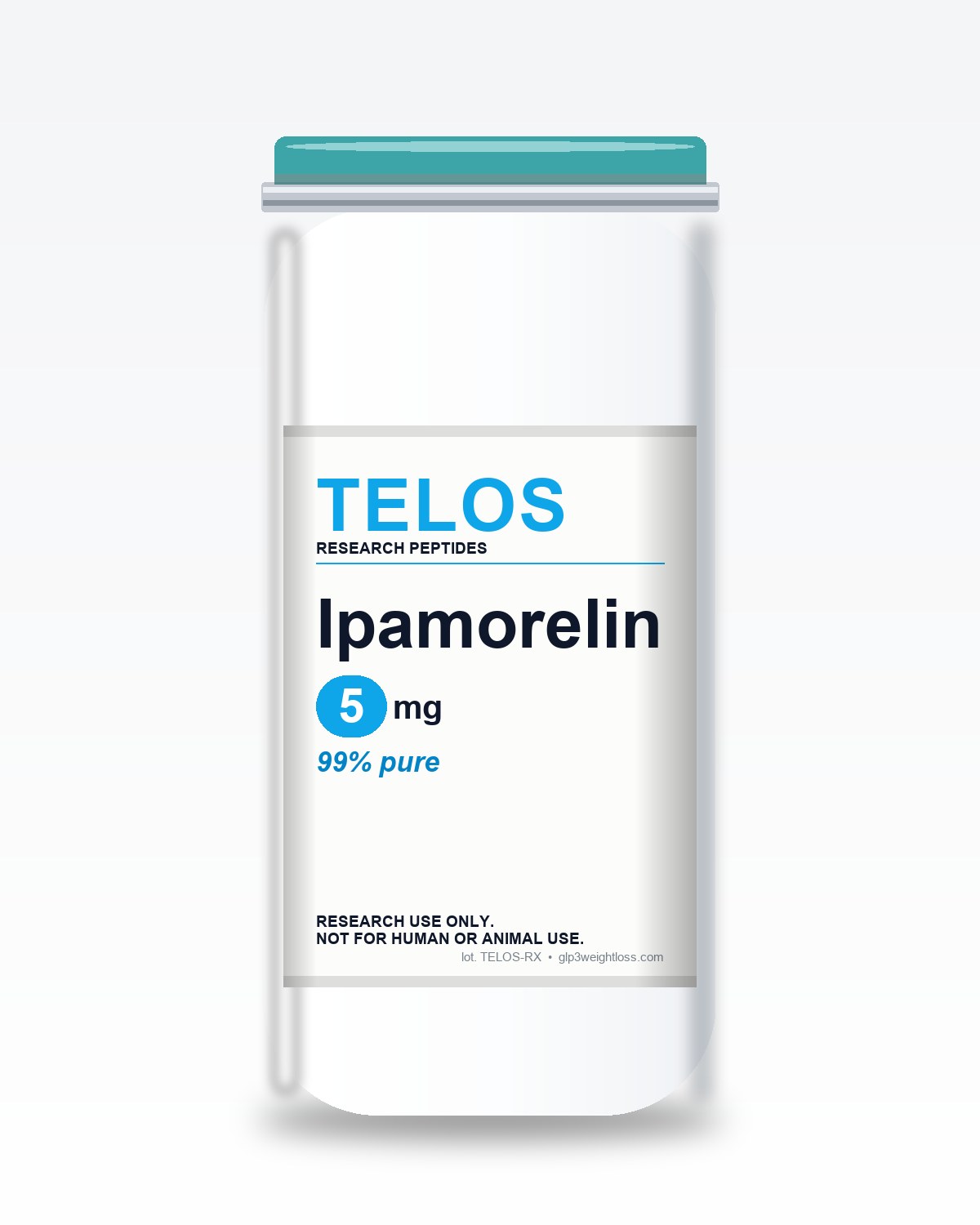
What Ipamorelin is
Ipamorelin is a synthetic pentapeptide (Aib-His-D-2-Nal-D-Phe-Lys-NH₂) developed in the late 1990s by Novo Nordisk as a selective agonist of the growth hormone secretagogue receptor type 1a (GHS-R1a), the endogenous receptor for ghrelin (Raun et al., 1998 — PMID 9849822). Unlike earlier non-peptide GHS-R agonists, ipamorelin demonstrated minimal cross-reactivity with receptors governing prolactin, cortisol, ACTH, follicle-stimulating hormone, luteinizing hormone, or thyroid-stimulating hormone secretion, making it a useful tool compound for isolating GHS-R-driven GH release from broader endocrine perturbations.
Mechanism of action
Ipamorelin binds GHS-R1a, a class A G-protein-coupled receptor expressed primarily on hypothalamic arcuate-nucleus neurons and on pituitary somatotrophs. Receptor engagement signals through Gαq/11, activating phospholipase C and increasing intracellular calcium via IP₃-mediated mobilization, which evokes GH exocytosis from somatotroph secretory granules. Because GHS-R activation operates synergistically with endogenous GHRH and antagonistically with somatostatin tone, the resulting GH pulse is amplified when administered in combination with GHRH analogs and dampened during periods of high somatostatin output (Raun et al., 1998 — PMID 9849822). The peptide does not measurably activate the type-1b splice variant or unrelated GPCRs at physiologic concentrations.
Historical & structural context
Ipamorelin emerged from a structure-activity exploration of growth-hormone-releasing peptides (GHRPs) building on the discovery of GHRP-6 in the 1980s. Earlier GHRPs were potent GH secretagogues but lacked selectivity and were associated with secondary release of cortisol, prolactin, and ACTH. The medicinal-chemistry program that produced ipamorelin focused on minimizing these off-target endocrine effects while preserving GHS-R1a engagement. The pentapeptide structure incorporates non-natural residues — α-aminoisobutyric acid (Aib), D-2-naphthylalanine, and D-phenylalanine — that confer protease resistance and improved receptor binding kinetics relative to the natural-amino-acid GHRPs.
Methodological considerations
Practical considerations include (1) the importance of fasting state on baseline GH variability in pharmacodynamic studies; (2) tachyphylaxis with repeated dosing intervals shorter than the somatotroph repolarization period; (3) potential interaction with concurrent GHRH agonism, which can substantially amplify GH release and complicate single-agent characterization; (4) species differences in GHS-R1a expression, with rodent and primate models giving different magnitudes of response. Cell-culture work should validate GHS-R1a expression and signaling competency of the chosen line before interpreting null-result studies.
Research applications
Ipamorelin is used as a reference selective GHS-R agonist in:
- Mechanistic studies of GHRH/ghrelin axis interaction and synergy in pituitary perfusion systems.
- Investigation of ghrelin-axis effects on gastrointestinal motility and post-operative ileus models (Greenwood-Van Meerveld et al., 2011).
- Bone-formation pre-clinical models, including ovariectomized rat studies of trabecular bone density.
- Appetite, food-intake, and body-composition models in rodents.
- Comparator pharmacology against macimorelin, anamorelin, and other GHS-R-active compounds.
Stability & handling notes
Lyophilized ipamorelin is typically stable at −20 °C for 24 months. After reconstitution in bacteriostatic water or sterile saline, working aliquots are stored at 2–8 °C and used within ~14 days, with bulk stock retained at −20 °C. The molecule's two D-amino-acid residues (D-2-Nal, D-Phe) and α-aminoisobutyric acid (Aib) substitution confer relative resistance to proteolysis compared to native ghrelin, but oxidative degradation and aggregation are still possible at elevated temperatures.
Common research dosing reference
Published rodent investigations have used intravenous or subcutaneous bolus doses in the range of 1–90 μg/kg for acute GH-release pharmacodynamic studies. Cell-culture assays of pituitary somatotroph lines commonly use 1 nM to 1 μM. These figures are research benchmarks only and have no implication for clinical or human dosing.
Quality & specifications
Reference-grade material is typically characterized by reverse-phase HPLC purity ≥98%, electrospray-ionization mass spectrometry (ESI-MS) confirming the expected monoisotopic mass, and quantitative amino-acid analysis where applicable. Cell-culture-grade lots additionally include endotoxin testing by Limulus amebocyte lysate (LAL) assay and bioburden screening. Each lot is shipped with a Certificate of Analysis itemizing purity, identity, residual solvents, water content (Karl Fischer), and acetate or trifluoroacetate counter-ion content where relevant. Investigators evaluating new lots should request raw chromatograms and mass spectra prior to incorporation into published work.
Pharmacology in context
Ipamorelin sits in a structure-activity continuum from the original natural-amino-acid GHRPs (GHRP-2, GHRP-6, hexarelin) through later non-peptide GHS-R agonists (MK-0677/ibutamoren, anamorelin, macimorelin) and partial agonists. Within this series, ipamorelin is distinguished by its high selectivity for GHS-R1a-mediated GH release without parallel cortisol or prolactin elevation, which makes it a useful tool compound for isolating somatotroph effects from broader hypothalamic-pituitary perturbations. Comparative pharmacology against MK-0677, anamorelin, and macimorelin in pituitary perfusion and rodent models has helped delineate functional-selectivity differences among GHS-R agonists.
Reporting & reproducibility expectations
Publications using ipamorelin should report: (a) supplier, lot, HPLC purity, and mass-spec verification confirming the expected pentapeptide sequence; (b) reconstitution buffer and storage history; (c) dosing route and pre-dose fasting state, since ghrelin-axis tone varies sharply with feeding; (d) sampling intervals appropriate to the peptide's short circulating half-life (peak GH within 15–30 min of subcutaneous administration in most species); (e) baseline endocrine values for cortisol and prolactin in cases where selectivity is part of the claim being made; (f) any concurrent GHRH agonist, since combination effects can substantially alter readouts.
Compliance & regulatory framing
This material is provided strictly for research and educational reference. The compound is supplied for in vitro investigation and laboratory characterization only and is not intended for human ingestion, injection, topical use, or any clinical application. Federal and state law treats research peptides as non-therapeutic chemicals; recipients are responsible for compliance with all applicable institutional, state, and federal regulations governing handling, storage, and disposal. Pricing, availability, and supply specifications are subject to change without notice. Request a Certificate of Analysis (COA), HPLC chromatograms, mass-spec verification, or compliance documentation from the GLP3 Weight Loss Editorial Team for any specific lot.
Related research compounds
Co-referenced peptides include the GHRH analog CJC-1295, the dual CJC-1295 + Ipamorelin 10 mg blend, and Tesamorelin 15 mg for comparative GH-axis pharmacology.
Comparative selectivity profile
Among the GHS-R1a agonist class, ipamorelin is frequently chosen as a reference selective tool compound because of its documented lack of substantial cortisol, prolactin, ACTH, FSH, LH, or TSH release at GH-effective concentrations in the primary characterization studies. This selectivity profile distinguishes it from earlier natural-amino-acid GHRPs (GHRP-2, GHRP-6, hexarelin), which produce parallel cortisol and prolactin release that confounds isolation of somatotroph-specific pharmacology. Investigators evaluating selectivity claims in their own systems should include explicit measurements of the off-target endocrine axes rather than relying on extrapolation from earlier characterization, since some species and disease-state contexts may show responses not captured in the original profiling work.
Sourcing & analytical verification
Investigators sourcing ipamorelin for research should request lot-specific HPLC chromatograms, mass-spec data confirming the expected monoisotopic mass for the pentapeptide (approximately 711.86 Da for the free base), and quantitative amino-acid analysis where the protocol requires absolute concentration accuracy. Lot-to-lot variability in commercial peptide preparations is a documented source of irreproducibility across the GH-secretagogue literature, and orthogonal verification of identity and purity is strongly recommended before incorporation into published work. Endotoxin testing by LAL assay is essential for cell-culture applications, particularly in pituitary and somatotroph cell lines that are highly responsive to lipopolysaccharide contamination through innate-immunity pathways that can confound endocrine readouts.
References
References below are anchor PubMed citations. Readers are encouraged to verify each in the National Library of Medicine database before using as a research source.
- Raun K, et al. Ipamorelin, the first selective growth hormone secretagogue. European Journal of Endocrinology, 1998. PMID 9849822.
- Greenwood-Van Meerveld B, et al. Preclinical studies of ipamorelin and GI motility. Neurogastroenterology and Motility, 2011.
- Smith RG, et al. The growth hormone secretagogue receptor and ghrelin. Endocrine Reviews, 2005. PMID 15814848.
- Andersen NB, et al. Ipamorelin and bone formation in ovariectomized rats. Bone, 2001.
- Johansen PB, et al. Ipamorelin pharmacokinetics in animal models. Growth Hormone & IGF Research, 1999.
- Smith RG. Development of growth hormone secretagogues. Endocrine Reviews, 2005. PMID 15814848.
For Research Use Only. Not for human or veterinary consumption, diagnostic procedures, or therapeutic use. Content is educational and non-promotional.