← Back to WP3 Peptides & Research Index
What MOTS-c is
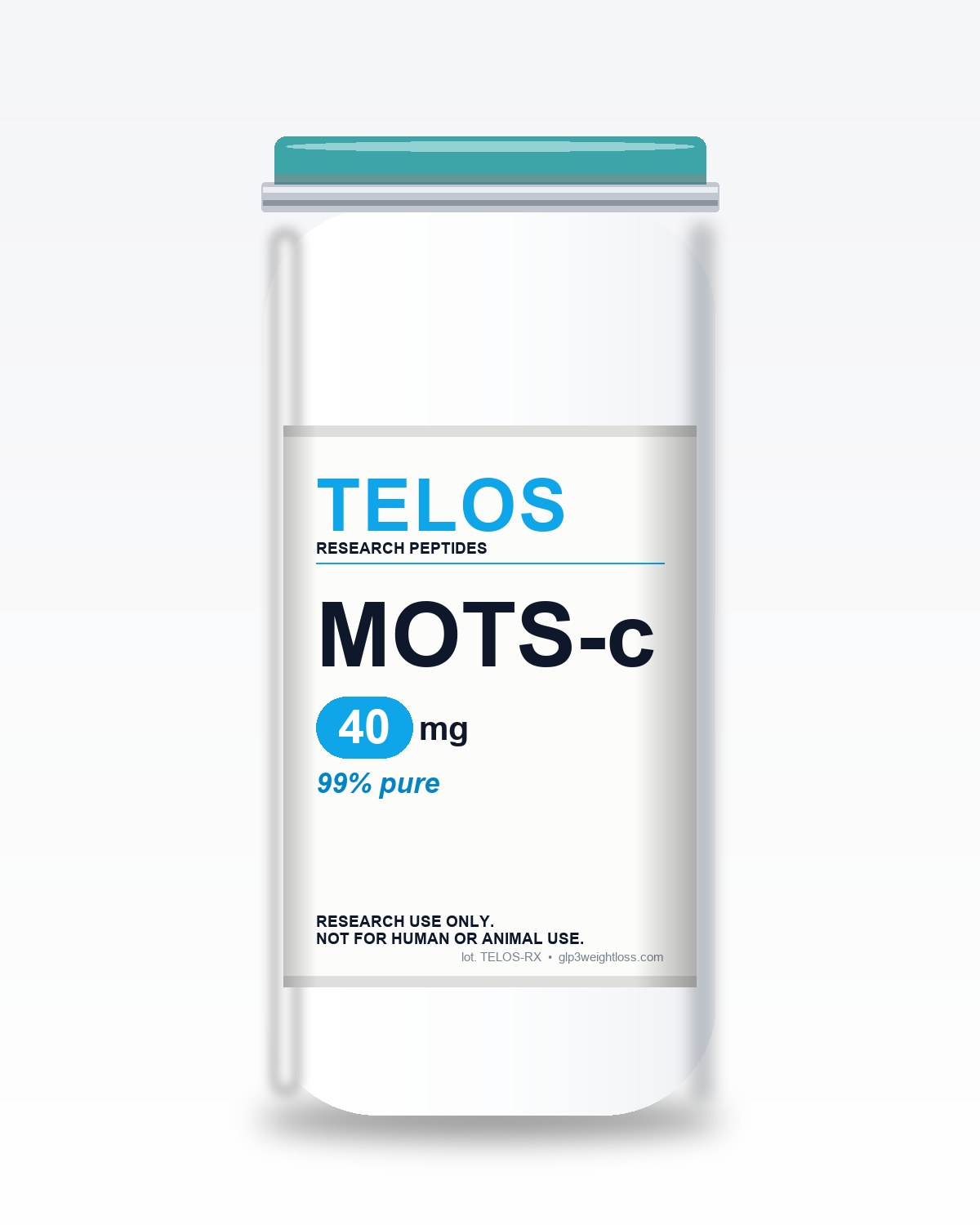
MOTS-c (Mitochondrial Open Reading Frame of the Twelve S rRNA type-c) is a 16-amino-acid peptide encoded within the mitochondrial 12S rRNA gene, first characterized by Lee and colleagues in 2015. It belongs to a class of mitochondrial-derived peptides (MDPs) that includes humanin and the SHLP family. MOTS-c is detectable in plasma, skeletal muscle, and other metabolically active tissues, and circulating concentrations decline with age and obesity. The peptide has emerged as a candidate signaling molecule between the mitochondrial and nuclear genomes, with documented effects on the AMP-activated protein kinase (AMPK) pathway, glucose disposal, and the cellular response to metabolic stress in pre-clinical models.
Mechanism of action
MOTS-c is proposed to act as a metabolic regulator that translocates to the nucleus under stress conditions and modulates nuclear gene expression in concert with the integrated stress response. The canonical mechanism described in the original characterization paper centers on activation of AMPK in skeletal muscle, secondary to perturbation of the folate–methionine cycle and accumulation of 5-aminoimidazole-4-carboxamide ribonucleotide (AICAR). Downstream AMPK activation increases GLUT4-mediated glucose uptake, enhances fatty-acid oxidation, and promotes mitochondrial biogenesis through PGC-1α. A second body of work has identified nuclear translocation of MOTS-c under glucose restriction and oxidative stress, where the peptide co-regulates antioxidant response element (ARE) and nuclear factor erythroid 2–related factor 2 (NRF2) target genes (Kim et al., 2018 — PMID 29983246). MOTS-c does not have a confirmed canonical receptor; current models invoke direct intracellular signaling and possible interaction with mitochondrial membrane components.
Historical & structural context
The discovery of MOTS-c grew out of bioinformatic interrogation of small open reading frames within the mitochondrial genome. The mitochondrial 12S rRNA gene was previously assumed to encode only structural ribosomal RNA, but in-silico scanning identified a 51-nucleotide ORF whose translated product is the 16-amino-acid MOTS-c peptide. Translation occurs in the cytoplasm rather than within the mitochondrion, distinguishing MOTS-c from canonically mitochondrial-translated proteins such as the 13 components of the electron-transport chain. The peptide has been detected in plasma at low nanomolar concentrations and is conserved across vertebrate species, which is consistent with a functional rather than vestigial role.
Methodological considerations
Researchers working with MOTS-c should anticipate several methodological constraints: (1) the peptide's relatively short circulating half-life requires careful timing of pharmacodynamic readouts; (2) AMPK activation is exquisitely sensitive to glucose, AMP/ATP ratio, and stress conditions, so vehicle-only controls must rigorously match metabolic state; (3) commercial ELISA kits for MOTS-c quantification show variable specificity and should be validated against mass-spectrometry methods; (4) reported phenotypes in skeletal-muscle models can depend on AMPK isoform composition (α1 vs α2) of the cell line or muscle group studied. Reproducibility is improved by reporting full reconstitution buffer composition, dosing route, time-of-day of administration (given AMPK circadian variability), and feeding state of animals.
Research applications
MOTS-c has been examined across several pre-clinical domains. The most cited investigations include:
- Insulin sensitivity and glucose homeostasis in diet-induced obese rodents (Lee et al., 2015 — PMID 25738459).
- Exercise capacity, skeletal-muscle mitochondrial biogenesis, and physical-performance models in aged mice (Reynolds et al., 2021).
- Bone metabolism and osteoclast differentiation in ovariectomy models (Kim et al., 2019).
- Cardiometabolic and endothelial-function assays in vitro.
- Aging biology, including senescence markers and the proposed mitochondrial–nuclear retrograde signaling axis.
Investigators commonly use MOTS-c to interrogate AMPK-dependent versus AMPK-independent metabolic adaptations, and to dissect the contribution of mitochondrial-encoded peptides to whole-organism phenotypes.
Stability & handling notes
Lyophilized MOTS-c is generally stable at −20 °C for extended periods (typically 24 months from the date of manufacture). After reconstitution in bacteriostatic water or sterile saline, working solutions should be aliquoted to minimize freeze–thaw cycles and stored at −20 °C; aliquots in active use are typically kept at 2–8 °C for no more than 14 days. The peptide is sensitive to repeated freeze–thaw and to oxidation; investigators should document storage conditions in published work to support reproducibility.
Common research dosing reference
The following dosing references are summarized from published animal studies and are presented solely as in vitro / in vivo research benchmarks. They are not therapeutic guidance and have no implication for human use. Reported intraperitoneal regimens in murine studies have included 0.5–15 mg/kg over multi-week protocols, with the original 2015 characterization paper using 0.5 mg/kg/day in C57BL/6 mice. Cell-culture work commonly uses 1–10 μM for AMPK pathway readouts.
Quality & specifications
Reference-grade material is typically characterized by reverse-phase HPLC purity ≥98%, electrospray-ionization mass spectrometry (ESI-MS) confirming the expected monoisotopic mass, and quantitative amino-acid analysis where applicable. Cell-culture-grade lots additionally include endotoxin testing by Limulus amebocyte lysate (LAL) assay and bioburden screening. Each lot is shipped with a Certificate of Analysis itemizing purity, identity, residual solvents, water content (Karl Fischer), and acetate or trifluoroacetate counter-ion content where relevant. Investigators evaluating new lots should request raw chromatograms and mass spectra prior to incorporation into published work.
Pharmacology in context
MOTS-c sits within a broader class of mitochondrial-derived peptides that has expanded considerably since the 2003 discovery of humanin. Other characterized MDPs include the small humanin-like peptides SHLP1 through SHLP6, each translated from short ORFs in the mitochondrial 16S rRNA gene, and the more recently described MOTS-c family. Comparative pharmacology across these peptides has revealed both overlapping and distinct phenotypes — humanin is principally cytoprotective in neuronal models, the SHLPs vary in metabolic and apoptotic effects, and MOTS-c is the most consistently characterized for skeletal-muscle and whole-body metabolic regulation. Investigators evaluating MOTS-c phenotypes should therefore be cautious in extrapolating findings to the broader MDP family, and conversely, in assuming that MOTS-c effects are independent of co-secreted MDPs in vivo.
Reporting & reproducibility expectations
Publications using MOTS-c should at minimum report: (a) supplier and lot number; (b) HPLC purity and mass-spec verification of the specific lot used; (c) reconstitution buffer, concentration, and storage history including freeze–thaw cycles; (d) dosing route, vehicle composition, time of day, and feeding state for in vivo work; (e) AMPK-pathway readout method (Western for phospho-AMPK Thr172, kinase activity assay, or downstream target phosphorylation such as ACC Ser79); (f) full statistical pre-registration or analysis plan where appropriate. These reporting elements substantially improve cross-laboratory reproducibility for a peptide whose phenotypes can be modest in magnitude and sensitive to metabolic state.
Compliance & regulatory framing
This material is provided strictly for research and educational reference. The compound is supplied for in vitro investigation and laboratory characterization only and is not intended for human ingestion, injection, topical use, or any clinical application. Federal and state law treats research peptides as non-therapeutic chemicals; recipients are responsible for compliance with all applicable institutional, state, and federal regulations governing handling, storage, and disposal. Pricing, availability, and supply specifications are subject to change without notice. Request a Certificate of Analysis (COA), HPLC chromatograms, mass-spec verification, or compliance documentation from the GLP3 Weight Loss Editorial Team for any specific lot.
Related research compounds
Investigators studying mitochondrial-derived peptides and metabolic signaling may also reference the related research summaries for NAD+ 1000 mg and Tesamorelin 15 mg.
References
References below are anchor PubMed citations. Readers are encouraged to verify each in the National Library of Medicine database before using as a research source.
- Lee C, et al. The mitochondrial-derived peptide MOTS-c promotes metabolic homeostasis and reduces obesity and insulin resistance. Cell Metabolism, 2015. PMID 25738459.
- Kim KH, et al. Mitochondrially derived peptides as novel regulators of metabolism. Journal of Physiology, 2018. PMID 29983246.
- Reynolds JC, et al. MOTS-c is an exercise-induced mitochondrial-encoded regulator of age-dependent physical decline and muscle homeostasis. Nature Communications, 2021.
- Kim SJ, et al. The mitochondrial-derived peptide MOTS-c is a regulator of plasma metabolites and enhances insulin sensitivity. Physiological Reports, 2019.
- Merry TL, et al. Mitochondrial-derived peptides in energy metabolism. American Journal of Physiology – Endocrinology and Metabolism, 2020.
- Lee C, Kim KH, Cohen P. MOTS-c: a novel mitochondrial-derived peptide regulating muscle and fat metabolism. Free Radical Biology and Medicine, 2016.
For Research Use Only. Not for human or veterinary consumption, diagnostic procedures, or therapeutic use. Content is educational and non-promotional.