← Back to WP3 Peptides & Research Index
What GHK-Cu is
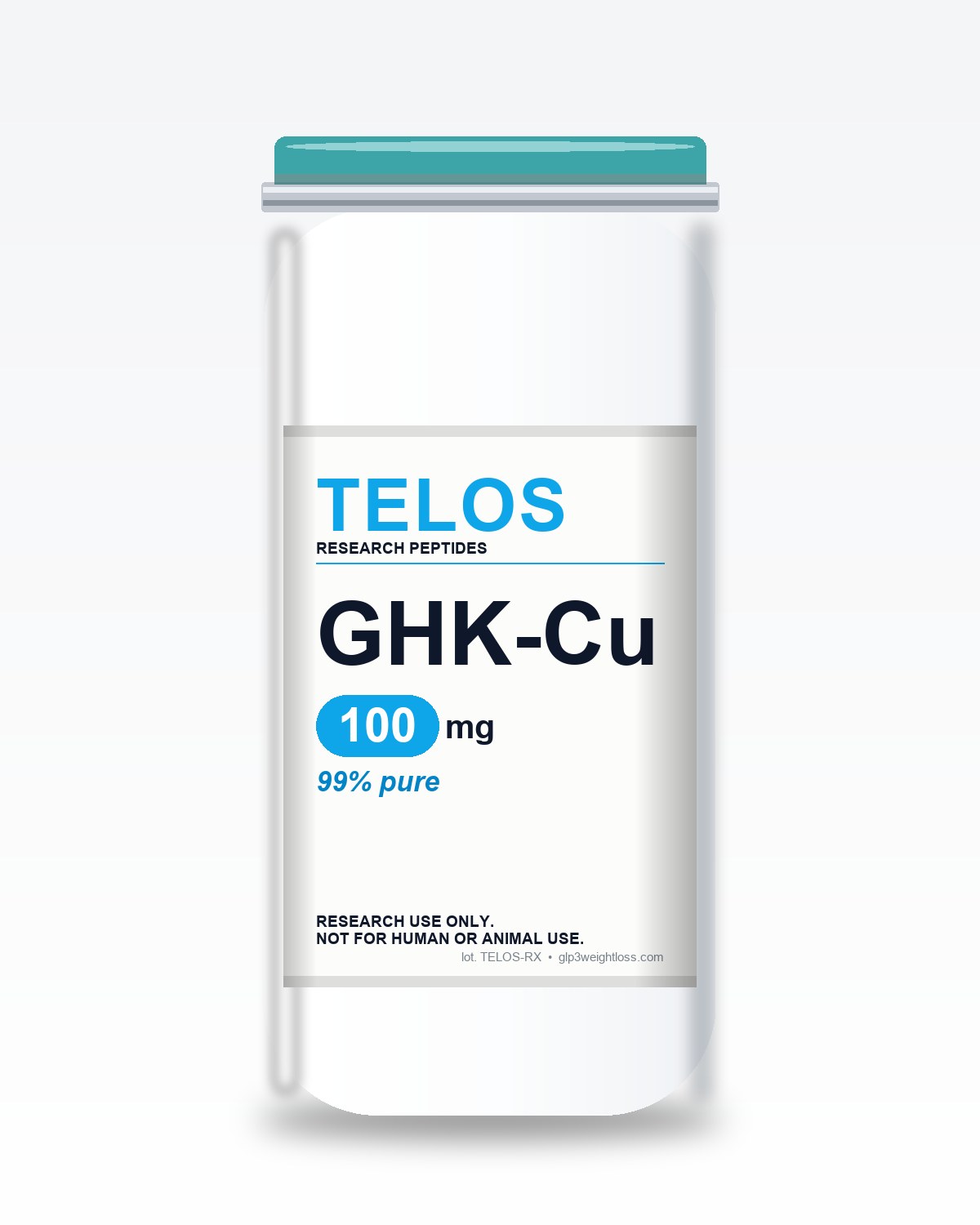
GHK-Cu is a naturally occurring copper-binding tripeptide consisting of glycyl-L-histidyl-L-lysine in 1:1 complex with divalent copper (Cu²⁺), first isolated from human plasma by Pickart and Thaler in 1973 (Pickart & Thaler, 1973 — PMID 4356974). Plasma GHK levels decline with age, from approximately 200 ng/mL in adults aged 20 to roughly 80 ng/mL by age 60. The peptide chelates copper with high affinity and is studied in models of skin biology, dermal wound environments, hair-follicle research, antioxidant defense, and gene-expression modulation.
Mechanism of action
GHK-Cu participates in copper transport between extracellular albumin and tissue, and modulates expression of a broad transcriptional program that includes extracellular-matrix components, antioxidant enzymes, and DNA-repair genes. In dermal fibroblast cultures, GHK-Cu has been reported to upregulate type I collagen, decorin, and metalloproteinase-2 expression while modulating TGF-β signaling. A 2010 microarray analysis demonstrated that GHK at 1 μM modulates expression of more than 4,000 human genes, with consistent downregulation of pro-inflammatory and pro-senescence transcripts and upregulation of mitochondrial-biogenesis and DNA-repair pathways (Pickart, 2012 — PMID 18644225). Copper coordination is required for several of these activities, suggesting redox-active and copper-dependent enzymatic effects rather than a single canonical receptor.
Historical & structural context
The tripeptide GHK was identified in 1973 as a plasma factor that prolonged hepatocyte viability in culture; subsequent biochemical characterization revealed that the active moiety was the GHK-Cu²⁺ complex rather than the apo-peptide. Plasma GHK levels decline approximately threefold between ages 20 and 60, motivating subsequent investigation of the peptide's role in age-related tissue-repair capacity. The molecule's small size (340 Da for the apo-peptide, ~404 Da for the copper complex) and high copper affinity (log K ≈ 16.4 at physiological pH) place it among the highest-affinity copper-binding peptides characterized in humans.
Methodological considerations
Practical considerations for GHK-Cu work include (1) maintaining the copper complex during dilution — common cell-culture media contain chelators that can strip copper from the peptide, so reconstitution is best performed in defined buffers; (2) avoiding reducing agents (DTT, β-mercaptoethanol, ascorbate) in working solutions, as Cu²⁺ to Cu¹⁺ reduction destabilizes the complex; (3) controlling for free-copper effects with apo-peptide and copper-only controls; (4) light protection during handling, since photoreduction can occur with prolonged ambient exposure. Gene-expression studies should validate ATP7A/ATP7B copper-transporter activity in the chosen cell model, since cellular copper handling modulates downstream signaling.
Research applications
The peptide-copper complex is investigated in:
- Dermal wound-healing and matrix-remodeling models, including studies of glycosaminoglycan and collagen synthesis (Maquart et al., 1988 — PMID 3169264).
- Hair-follicle biology and minoxidil-comparator dermal studies.
- Antioxidant and anti-inflammatory profiling in keratinocyte and fibroblast cultures (Pickart, 2012 — PMID 18644225).
- Lung-tissue repair and chronic obstructive pulmonary disease (COPD) gene-signature reversal studies (Campbell et al., 2012).
- Cell-culture aging and senescence-marker investigations.
Stability & handling notes
Lyophilized GHK-Cu is typically stable at −20 °C for 24 months protected from light. After reconstitution in sterile water, the complex is light-sensitive and is best stored in amber vials or wrapped to exclude light, at 2–8 °C, with use within approximately 14 days. Reducing agents (ascorbate, glutathione) and chelators (EDTA) must be excluded from working buffers as they will compete for or reduce the bound copper.
Common research dosing reference
In vitro fibroblast and keratinocyte assays commonly employ 0.1 nM to 10 μM. Topical formulations in dermal-research literature have used 0.05–2% (w/w). Rodent subcutaneous and intraperitoneal regimens have used 0.5–5 mg/kg in published wound-healing models. These values are research benchmarks only and have no implication for therapeutic application or human cosmetic use.
Quality & specifications
Reference-grade material is typically characterized by reverse-phase HPLC purity ≥98%, electrospray-ionization mass spectrometry (ESI-MS) confirming the expected monoisotopic mass, and quantitative amino-acid analysis where applicable. Cell-culture-grade lots additionally include endotoxin testing by Limulus amebocyte lysate (LAL) assay and bioburden screening. Each lot is shipped with a Certificate of Analysis itemizing purity, identity, residual solvents, water content (Karl Fischer), and acetate or trifluoroacetate counter-ion content where relevant. Investigators evaluating new lots should request raw chromatograms and mass spectra prior to incorporation into published work.
Pharmacology in context
Copper-binding peptides constitute a small but biologically significant class that includes GHK-Cu, the copper-binding domain of human serum albumin, and several histidine-rich proteins. GHK-Cu is distinguished by its small size, high copper affinity, and broad transcriptional effects in dermal and other tissues. Related research compounds include AHK-Cu (alanyl-histidyl-lysine-Cu) and copper-bound peptide cosmetic ingredients, though most have not been characterized to the depth of GHK-Cu. The peptide's wide-ranging gene-expression effects make it a useful tool for probing copper-dependent transcriptional regulation, but also impose interpretive challenges, since few cellular pathways are demonstrably independent of copper status.
Reporting & reproducibility expectations
Publications using GHK-Cu should report: (a) supplier, lot, HPLC purity, and mass-spec verification of both the apo-peptide and the copper complex; (b) molar ratio of copper to peptide, since some commercial preparations vary; (c) reconstitution buffer, with explicit absence of reducing agents and chelators; (d) light-protection conditions during handling; (e) for transcriptomic work, the analytical platform, normalization method, and statistical thresholds; (f) appropriate apo-peptide and copper-only controls to distinguish complex-specific effects from free-copper effects. These reporting standards address the principal sources of variation in published GHK-Cu pharmacology.
Compliance & regulatory framing
This material is provided strictly for research and educational reference. The compound is supplied for in vitro investigation and laboratory characterization only and is not intended for human ingestion, injection, topical use, or any clinical application. Federal and state law treats research peptides as non-therapeutic chemicals; recipients are responsible for compliance with all applicable institutional, state, and federal regulations governing handling, storage, and disposal. Pricing, availability, and supply specifications are subject to change without notice. Request a Certificate of Analysis (COA), HPLC chromatograms, mass-spec verification, or compliance documentation from the GLP3 Weight Loss Editorial Team for any specific lot.
Related research compounds
Investigators studying tissue-repair and matrix biology often co-reference TB-500 10 mg for actin-dependent cell-migration assays and MOTS-c 40 mg for cellular-stress and senescence pathways.
Sourcing & analytical verification
Investigators sourcing GHK-Cu should request HPLC chromatograms, mass-spec verification of both apo-peptide (approximately 340 Da) and copper complex (approximately 404 Da), and a documented copper-to-peptide molar ratio. Some commercial preparations are sold as the apo-peptide for in-house copper loading, while others are pre-complexed; protocols must specify which form was used. UV-visible spectroscopy can provide a quick verification of intact complex formation, since GHK-Cu shows a characteristic d-d transition absorbance band near 525 nm. Endotoxin testing is required for cell-culture applications, particularly in keratinocyte and fibroblast assays where TLR-mediated inflammatory readouts can confound matrix-remodeling phenotypes attributed to the peptide.
References
References below are anchor PubMed citations. Readers are encouraged to verify each in the National Library of Medicine database before using as a research source.
- Pickart L, Thaler MM. A synthetic tripeptide which increases survival of normal liver cells, and stimulates growth in hepatoma cells. Biochemical and Biophysical Research Communications, 1973. PMID 4356974.
- Pickart L. The human tri-peptide GHK and tissue remodeling. Journal of Biomaterials Science: Polymer Edition, 2008/2012. PMID 18644225.
- Maquart FX, et al. Stimulation of collagen synthesis in fibroblast cultures by the tripeptide-copper complex glycyl-L-histidyl-L-lysine-Cu²⁺. FEBS Letters, 1988. PMID 3169264.
- Campbell JD, et al. The peptide GHK-Cu reverses gene-expression changes associated with COPD. Genome Medicine, 2012.
- Pickart L, Vasquez-Soltero JM, Margolina A. GHK peptide as a natural modulator of multiple cellular pathways in skin regeneration. BioMed Research International, 2015. PMID 26236730.
- Pickart L, Margolina A. Regenerative and protective actions of the GHK-Cu peptide. International Journal of Molecular Sciences, 2018.
For Research Use Only. Not for human or veterinary consumption, diagnostic procedures, or therapeutic use. Content is educational and non-promotional.