← Back to WP3 Peptides & Research Index
What TB-500 is
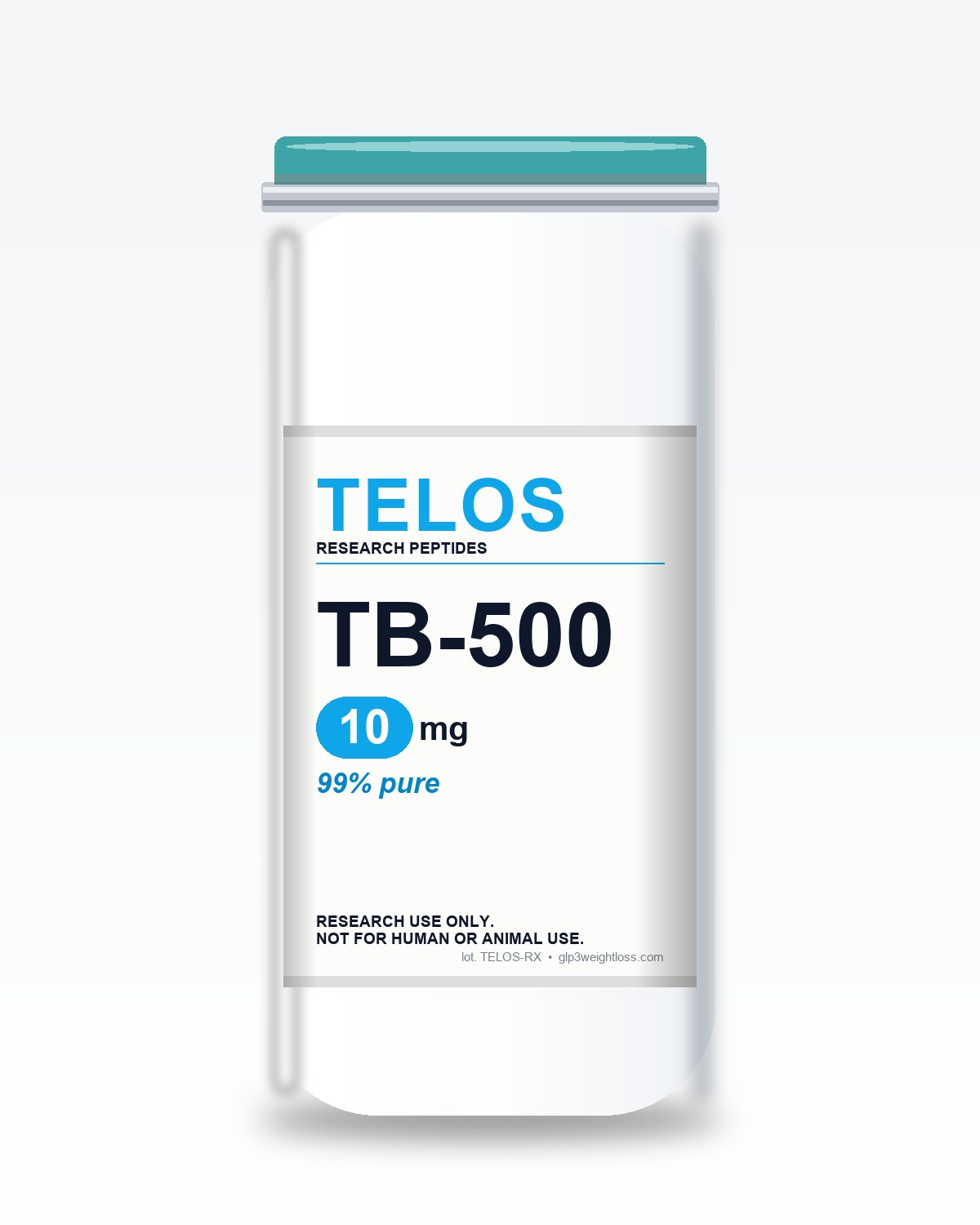
TB-500 is a synthetic peptide corresponding to the active region (residues 17–23, the LKKTETQ motif and adjacent sequence) of thymosin beta-4 (Tβ4), a 43-amino-acid endogenous peptide that is one of the most abundant intracellular G-actin-sequestering proteins in mammalian cells. Thymosin beta-4 was first isolated from calf thymus and is highly conserved across vertebrate species. Pre-clinical investigations of TB-500 and full-length Tβ4 examine cell migration, angiogenesis, and tissue-repair processes in cardiac, dermal, corneal, and neural injury models. The fragment is studied because much of the cytoprotective and migratory activity of Tβ4 has been mapped to the N-terminal region that TB-500 represents.
Mechanism of action
The principal documented activity of thymosin beta-4 is sequestration of monomeric G-actin via its actin-binding motif, regulating the G-actin/F-actin equilibrium that governs cell motility, cytoskeletal remodeling, and wound closure. Beyond actin binding, TB-500 and Tβ4 have been shown to upregulate vascular endothelial growth factor (VEGF) signaling, promote endothelial-cell migration and tube formation in Matrigel assays, and modulate the inflammatory response by suppressing NF-κB activation in injury models (Bock-Marquette et al., 2004). Additional work has implicated Tβ4 in laminin-5 induction in keratinocytes, accelerating epithelialization in cutaneous wound models, and in upregulation of stem-cell mobilization markers in cardiac progenitor populations.
Historical & structural context
Thymosin beta-4, the parent molecule, was first isolated from bovine thymic extract in 1981 and subsequently shown to be a ubiquitous intracellular G-actin-sequestering protein present at concentrations of 100–500 μM in many cell types. The active region was mapped to the N-terminal domain containing the LKKTETQ actin-binding motif. TB-500 corresponds to a peptide fragment that retains this binding motif while being more readily synthesizable than the full-length 43-residue protein. Both the full-length molecule and the fragment are studied across vertebrate models, and the conservation of the actin-binding region across species supports its central role in cytoskeletal regulation.
Methodological considerations
Investigators working with TB-500 should consider that (1) actin-sequestration assays depend on the ratio of peptide to total cellular G-actin, which varies widely by cell type; (2) wound-healing readouts in dermal models are confounded by mechanical variation in punch-biopsy depth, so blinded measurement protocols are recommended; (3) endothelial-tube-formation assays in Matrigel are highly batch-sensitive — investigators should source matrix from a single lot for any given study; (4) the LKKTETQ motif binds G-actin but also interacts with several non-actin partners, so phenotypes attributed to actin sequestration should be verified with motif-mutant peptides where possible.
Research applications
Pre-clinical and in vitro investigations have spanned several areas:
- Soft-tissue and dermal wound-healing models (Malinda et al., 1999 — PMID 10469335).
- Cardiac ischemia-reperfusion and myocardial repair after experimental infarction (Bock-Marquette et al., 2004 — PMID 15565145).
- Corneal wound healing and ocular surface repair models (Sosne et al., 2010 — PMID 20536468).
- Angiogenesis and endothelial-cell migration assays.
- Hair-follicle stem-cell migration and neurological injury models.
The peptide is frequently chosen as a tool compound to probe actin-dependent migration phenotypes that are difficult to address with cytoskeletal disruptors alone.
Stability & handling notes
Lyophilized TB-500 is typically stable at −20 °C for 24 months. Reconstituted solutions in sterile water or bacteriostatic water for injection should be aliquoted to avoid repeated freeze–thaw, with active aliquots stored at 2–8 °C and used within approximately 14 days. The peptide is hygroscopic; vials should be allowed to reach room temperature before opening to minimize moisture condensation.
Common research dosing reference
Published rodent dosing references commonly fall in the range of 100–600 μg/kg administered intraperitoneally or subcutaneously, with frequency varying by injury model. In vitro migration and tube-formation assays typically use 100 ng/mL to 1 μg/mL. These values are reported solely as research benchmarks for in vitro and in vivo experimental design and have no implication for human dosing.
Quality & specifications
Reference-grade material is typically characterized by reverse-phase HPLC purity ≥98%, electrospray-ionization mass spectrometry (ESI-MS) confirming the expected monoisotopic mass, and quantitative amino-acid analysis where applicable. Cell-culture-grade lots additionally include endotoxin testing by Limulus amebocyte lysate (LAL) assay and bioburden screening. Each lot is shipped with a Certificate of Analysis itemizing purity, identity, residual solvents, water content (Karl Fischer), and acetate or trifluoroacetate counter-ion content where relevant. Investigators evaluating new lots should request raw chromatograms and mass spectra prior to incorporation into published work.
Pharmacology in context
The thymosin family encompasses three structurally unrelated subgroups — α (thymosin α1, prothymosin α), β (Tβ4, Tβ10, Tβ15), and γ — sharing only the historical name from their original co-purification from thymic extracts. Within the β family, Tβ4 is the most abundant and the most studied for tissue-repair pharmacology, while Tβ10 and Tβ15 have distinct expression patterns and partially overlapping actin-binding activities. TB-500 corresponds to the active region of Tβ4 specifically; investigators interpreting findings should be cautious about generalizing to other β-thymosins or to thymosin α1, which has an entirely different mechanism centered on innate-immunity modulation rather than cytoskeletal regulation.
Reporting & reproducibility expectations
Publications using TB-500 should report: (a) supplier, lot, HPLC purity, and mass-spec confirmation; (b) full peptide sequence, since some commercial preparations marketed as TB-500 are actually full-length Tβ4 or alternative N-acetylated variants; (c) reconstitution buffer, working concentration, and storage history; (d) for wound-healing studies, the wound model (excisional vs incisional, full-thickness vs partial), wound dimensions, and blinding procedures for measurement; (e) for angiogenesis assays, Matrigel lot, plating density, and quantification method; (f) for cardiac models, infarct size verification by triphenyltetrazolium chloride or MRI. These reporting standards address the reproducibility challenges that have characterized parts of the tissue-repair peptide literature.
Compliance & regulatory framing
This material is provided strictly for research and educational reference. The compound is supplied for in vitro investigation and laboratory characterization only and is not intended for human ingestion, injection, topical use, or any clinical application. Federal and state law treats research peptides as non-therapeutic chemicals; recipients are responsible for compliance with all applicable institutional, state, and federal regulations governing handling, storage, and disposal. Pricing, availability, and supply specifications are subject to change without notice. Request a Certificate of Analysis (COA), HPLC chromatograms, mass-spec verification, or compliance documentation from the GLP3 Weight Loss Editorial Team for any specific lot.
Related research compounds
Investigators studying tissue-repair peptides may also reference GHK-Cu 100 mg for matrix and dermal-repair models, and MOTS-c 40 mg for cellular-stress signaling.
References
References below are anchor PubMed citations. Readers are encouraged to verify each in the National Library of Medicine database before using as a research source.
- Bock-Marquette I, et al. Thymosin beta4 activates integrin-linked kinase and promotes cardiac cell migration, survival and cardiac repair. Nature, 2004. PMID 15565145.
- Malinda KM, et al. Thymosin beta4 accelerates wound healing. Journal of Investigative Dermatology, 1999. PMID 10469335.
- Sosne G, et al. Thymosin beta 4 promotes corneal wound healing. Annals of the New York Academy of Sciences, 2010. PMID 20536468.
- Crockford D, et al. Thymosin beta4: structure, function, and biological properties supporting current and future clinical applications. Annals of the New York Academy of Sciences, 2010. PMID 20536467.
- Goldstein AL, Hannappel E, Sosne G, Kleinman HK. Thymosin beta4: a multi-functional regenerative peptide. Expert Opinion on Biological Therapy, 2012. PMID 22074294.
- Smart N, et al. Thymosin beta-4 induces adult epicardial progenitor mobilization and neovascularization. Nature, 2007. PMID 17108969.
For Research Use Only. Not for human or veterinary consumption, diagnostic procedures, or therapeutic use. Content is educational and non-promotional.